


Your SEO Audit is Finished – What Happens Next?
Realising that your website needed an SEO audit was a great starting point. Now you have a robust audit document; you understand what’s working, where your website is falling short and what could improve. So – what happens now?
It’s at this point, unfortunately, that many SEO audits are filed away and ultimately forgotten. Not because you disagree with it – quite the opposite – but because all those recommendations are jostling for headspace with everything else your business needs to do. Some of them sound technical, several sound time-consuming, and it’s hard to know where to begin.
And that’s a shame, because time, effort and money – your business’s money – has gone into this audit; you can’t let the impetus fade away now.
The important thing to remember is:
An SEO audit is a starting point, not the finished work.
This guide will help you to turn a document that’s probably long and packed with pages of recommendations you only half understand, into a manageable set of jobs with a practical action plan. You’ll be able to:
Start with what matters to your business
A good audit should explain its priorities, but those priorities still need to make sense in the context of your business. For example, a recommendation about a problem that affects your main source of enquiries almost certainly deserves attention before a more conspicuous technical warning on a page that very few customers visit.
When deciding what comes first, ask four questions:
Some website problems deserve prompt attention. For example, an important page accidentally excluded from Google, a broken enquiry form, or a checkout that doesn’t work well – these are all urgent issues that can prevent the website from doing its job.
Faulty tracking can also need an early fix if it leaves you unable to judge the impact of your changes. But an issue that’s marked “critical” in an automated audit tool doesn’t necessarily mean urgent for your business. I mean, a missing meta description is rarely an emergency!
If the audit report contains dozens of SEO recommendations and you still can’t see a sensible starting point, ask the person who prepared it: “Which two or three things would you do first, and why?” You shouldn’t have to decode a spreadsheet of red warnings on your own.
Turn recommendations into jobs someone can actually do
“Improve the service pages” may be sound advice, borne out of solid, data-based evidence, but it’s not much use as an item on a to-do list. Which pages? What needs to change? Who is the best person to do it?
Imagine this scenario: an SEO audit finds that a cleaning company only mentions office cleaning briefly on a general Services page, almost hidden amongst information about other types of cleaning service. This oversight could have untapped potential. Your next task could be formatted something like this:
- Decide whether “office cleaning” needs its own page.
- Research the questions potential customers ask
- Plan what the page should cover
- Write and publish it
- Link to the new page from the main Services page.
That example starts with a decision, not an assumption that creating another page is always the answer (this guide can help you decide if a service you offer should have its own page on your site). If the research supports it, the work can then be broken down and assigned to the most relevant person (see the next step). It also gives everyone a way to check that the page has been published, works properly and can be reached from the rest of the site.
Track your changes
For each recommendation you take forward, record the page or the part of the site involved, the next action, who owns it and what “done” means. A simple shared list is enough. You don’t need a complicated project management system to make progress.
I’ve used a Change Log for as long as I can remember, not just to record the actions following an SEO audit, but for any updates to a site with ongoing SEO – for years if necessary, if I’m working with a long-term client. It’s immensely helpful to look back at potential triggers for positive or negative impact, and of course it keeps everyone’s actions accountable and transparent.
Give each task an owner
Recommendations often get bogged down because everybody assumes that somebody else is dealing with them. In slightly larger teams:
In a smaller business, one person might cover several of those roles. That’s fine, as long as you’ve agreed who is doing what. If you have neither the time nor the relevant expertise in-house, ask your SEO consultant whether they can help implement the recommendations, or coordinate the people who can.
Choose a first set of work you can finish
Once you’ve settled on your business’s priorities and decided on the people involved, choose a small first set of connected actions. The right number depends on the size of the jobs and the resources available. For example, fixing a broken enquiry form, planning one new important service page, and setting up a reliable way to track enquiries could be plenty for a first phase.
Try to avoid picking tasks just because they’re easy to tick off. Sure, adding missing meta descriptions or image alt text makes you look busy, and there’s no denying it’s good to feel like you’re getting stuff done. But how much actual impact do those changes have?
A quick change is worth doing when it solves a real problem, or supports a more valuable piece of work. Equally, and for the same reasons, a larger job shouldn’t be put off indefinitely just because it takes more planning.
Agree a realistic order and timeframe with the people doing the work. If a new page needs research, writing, approval and development, allow for all four. A plan you can carry out is more useful than an ambitious deadline that overwhelms your team and doesn’t get done properly (or at all!).
Check the work, and its effect
A commitment to a large and potentially long implementation plan is far more likely to get buy-in from major stakeholders in the business if you can measure the results properly.
There are two different things to check.
First, was the work completed properly? Does the enquiry form submit successfully? Is the new page live, easy to use on a phone and linked from the relevant places? Technical changes may need a fresh crawl or a check in Google Search Console.
Second, is the work helping with the outcome you care about? Before you make changes, take a note of the starting position. For a Service page, that might include relevant search queries, impressions and clicks in Search Console, plus enquiries recorded in your analytics or customer records. A business that wants more qualified enquiries shouldn’t judge the work by rankings alone.
Visualising the implementation cycle
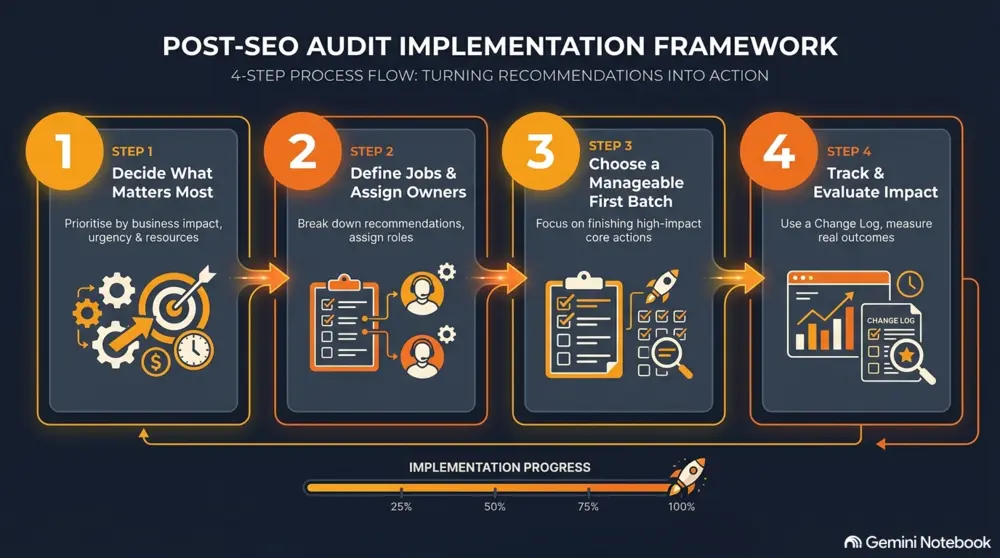
Google can take time to notice your changes
Give the changes time – it might take a few months for Google to catch up to the changes you’ve made – and look at the trending pattern rather than one good or bad week. It’s completely normal for Search performance to fluctuate.
A single change is often just the start
Recommendations from an SEO audit are often just the start of an ongoing cycle of updates, evaluation, insight and further action. For example, let’s say an important page on your site received more relevant visitors after your initial round of changes, but it didn’t lead to more enquiries. You may have fixed a visibility problem, but now you have a new issue to address: trying to improve that page’s conversion potential.
The point is, whatever it is you learn from measuring your changes, it should shape the next decision, and the next set of changes; it doesn’t have to prove that one isolated edit caused every change.
Keep the plan moving
After the first few jobs are finished, review what was completed, what you learned and what remains worthwhile. Some recommendations will become more important; others may no longer make sense.
An audit captures a point in time, while your action plan is a dynamic thing – it should change as your website and business change. And other factors can shift the plan in other directions, too – you have no control over competitors or algorithm updates, for example, but over time, they’re likely to influence what’s needed from your SEO work.
You don’t need to turn every recommendation into a project immediately. Start with the work that matters, give it an owner and make room to review the results. That’s how an SEO audit stops being a document you’ve filed away, and starts becoming useful work.
If you’ve found this guide helpful, you might also be interested in reading The Busy Marketing Manager’s Guide to SEO Priorities.
If you have an SEO audit but aren’t how to put it into practice, I can help you prioritise the recommendations and carry out the work that follows.

About Mandy Cochrane
Mandy Cochrane is an independent SEO consultant with more than 15 years’ experience helping businesses improve their visibility in search. She specialises in SEO audits, strategy and content, with a practical, plain-English approach that helps businesses understand what needs fixing, what matters most and where their time and budget will have the greatest impact.
Connect: