


The Busy Marketing Manager’s Guide to SEO Priorities
Why your SEO to-do list needs ruthless prioritisation, and how to decide what SEO work matters most.
SEO can involve an alarmingly wide-ranging set of tasks, but chasing every minor optimisation opportunity is rarely the best use of a busy marketing manager’s time and budget.
This guide explains why setting priorities matters, and helps you decide what SEO work matters most.
Key takeaway if you’re in a hurry: SEO to-do lists can grow endlessly, but your time, budget and resources can’t. The most effective SEO strategies are not the ones that fix every minor issue, but the ones that focus first on the work most likely to improve visibility, leads and commercial outcomes.
Why it’s easy to be overwhelmed
It’s a common scenario: your marketing team is overwhelmed by generic SEO checklists, automated site audits and well-meaning advice from every corner of the internet. But:
Without careful management, SEO distractions are everywhere. There’s a real danger of losing focus, or – without realising it – chasing SEO scorecards instead of commercial outcomes.
The infinite scope problem
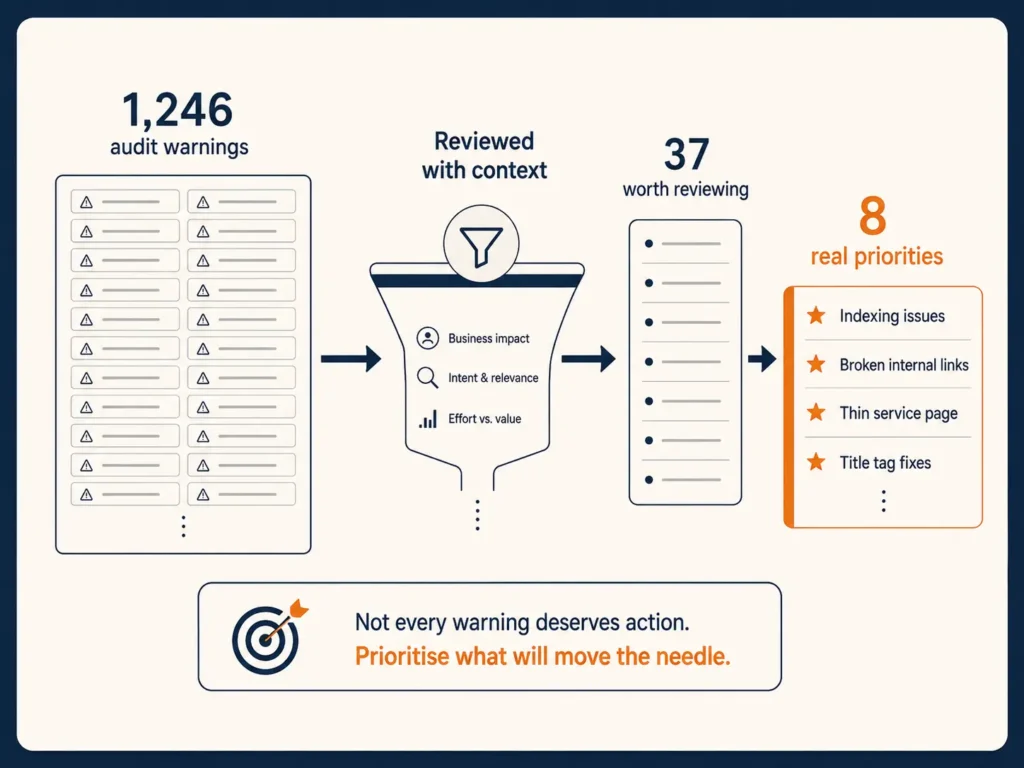
Here’s the heart of the problem: no matter how comprehensive and useful they are, SEO audits and checklists can span a massively broad scope covering code, copy, user experience, and off-site credibility.
When you don’t identify and cut out those low-impact actions, marketing teams can suffer from “output creep,” spending weeks fixing minor technical details while missing massive organic growth opportunities elsewhere.
Most marketing managers recognise that their SEO to-do list needs ruthless prioritisation – after all, SEO “to-do” lists grow infinitely, but your resources and budget are strictly finite.
A story that shines a light on “infinite scope”
A few years ago, I worked with a small but established B-to-B business with a relatively modest SEO budget. After all the up-front audits and strategy meetings had taken place, we had a fully approved plan. It focused our modest resources on the areas that were most likely to make a commercial difference.
The company director also liked to run their own SEO audit software in parallel with ours – I guess in those early days we hadn’t quite established the necessary level of trust yet. And every couple of weeks she brought to my attention another batch of warnings from her audit software, worried that I was overlooking issues that needed fixing.
I’d explore the listed issues – just to be sure I hadn’t missed something big. Then I’d sanity-check my original SEO strategy and justify it again to the client. I’d explain why these other opportunities and fixes were a lower priority than the tasks we’d agreed would have a faster and bigger impact.
And eventually, after burning through maybe 25% of that month’s retainer just on this ritual, the client would agree we should stick to the plan.
I still believe my approach was correct:
How to decide which SEO tasks need attention first
Clarify your business goals
It’s important to know what your business actually wants to achieve from SEO before tackling anything else.
Align your SEO priorities with your business goals – for example, improving your site’s visibility in SERPs to gain a larger market share, or boosting organic traffic to increase lead generation. Goals can be short- or long-term.
Conduct a comprehensive site review – but don’t let the audit become the strategy
A comprehensive audit of your site is the next foundational task. Everything flows from this. The audit must cover technical aspects, on-page optimisation, usability, off-site authority and trust signals.
I use a combination of Screaming Frog, Semrush, Google Search Console and ChatGPT to carry out many aspects of an SEO audit, but you can’t beat browsing through a site with your own two eyes and a dose of sound judgement to spot things that software doesn’t.
By the end of this review, you’ll probably have a pretty large list of everything that needs to be done – the challenge now switches to understanding what needs to be done first.
Score everything by impact, effort and commercial value
By the end of this process, you might have four priority lists:
- Critical issues: fix before doing anything else
- Tasks with high commercial value / conversion potential: do soon
- Useful but not urgent
- Window dressing: park or ignore
Fix the foundations
Before investing in new content or promotion, ensure search engines can actually read your site. If your foundation is broken, no other SEO work matters.
Outcome over output
The Pareto Principle of SEO is a useful way to think about SEO: a relatively small number of actions often drive a disproportionate share of your traffic, leads or revenue.
Broadly translated to something actionable, it means that when you’re prioritising your endless list of SEO tasks, steer your initiatives towards the highest impact opportunities. Focus on things that maximise search visibility while minimising implementation time.
Examples:
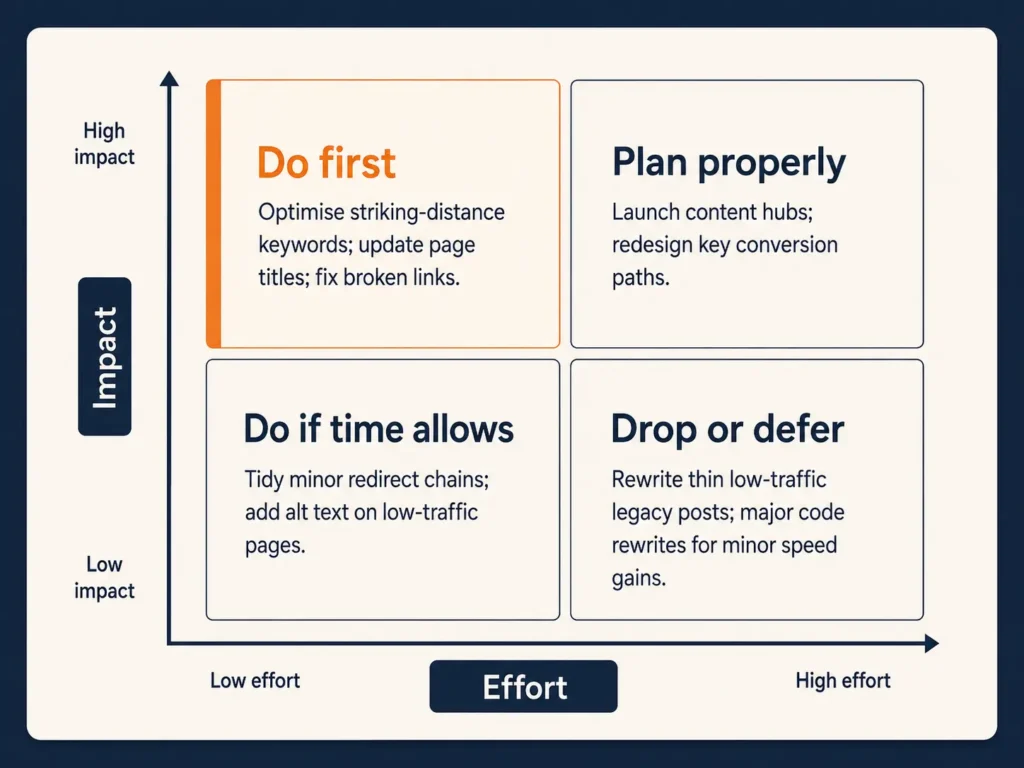
Evaluate effort vs impact
Evaluate every potential SEO task by weighing the development or implementation time required against the expected business return.
Focus on search intent over search volume
Ranking for a high-volume keyword is meaningless if it fails to attract buying customers. Start by researching the different reasons your customers search for something, i.e. their intent. For example, during a research phase their search intent is informational (top of funnel), but it becomes commercial or transactional once they’re closer to purchase (bottom of funnel).
Prioritise keywords by asking what role they play in the buying journey. High-intent commercial searches often deserve urgent attention, but some informational searches are still valuable if they attract the right audience, answer a genuine sales question, or help build trust during someone’s research phase.
Capture “striking distance” keywords
Look for pages that already rank on the second page of Google (positions 11 to 20). You can identify these using data from your GSC Performance report, or you can use tools like Ahrefs or Semrush.
Improving a page that already ranks in positions 11–20 is often more efficient than building a new page from scratch, and can deliver traffic gains faster.
How?
Don’t be distracted by constant algorithm changes
Google continuously modifies its search systems – hundreds of times a year, in fact. Google sometimes announces big core updates, but many updates are merely suspected. Each real or suspected event generates much chatter and theories in the industry about their supposed impact, which can easily distract your focus.
Use limited resources effectively
Not everyone has a large retainer with an SEO consultant or developer standing by, and not everyone has sufficient in-house resources to implement every high priority SEO task.
Prioritisation is not just about what matters most. It’s also about who is best placed to do the work.
My recommendations if resources are limited:
Don’t underestmate the cost-effectiveness of using an expert to outsource the initial SEO site audit, or even a small monthly retainer for ongoing SEO consultation – the saying “Do it once, do it right” is apt in terms of using a limited budget wisely.
Reassess your priorities regularly, and track performance
An effective SEO strategy may need to evolve over time as performance data becomes available, or as competitors rise or fall, so tracking is important. GSC and GA4 are both free, and can be used effectively to monitor performance trends. Semrush or Ahrefs (subscription required) are good for monitoring competitors.
Be prepared to adapt your priorities on the basis of performance outcomes.
Managing stakeholder demands
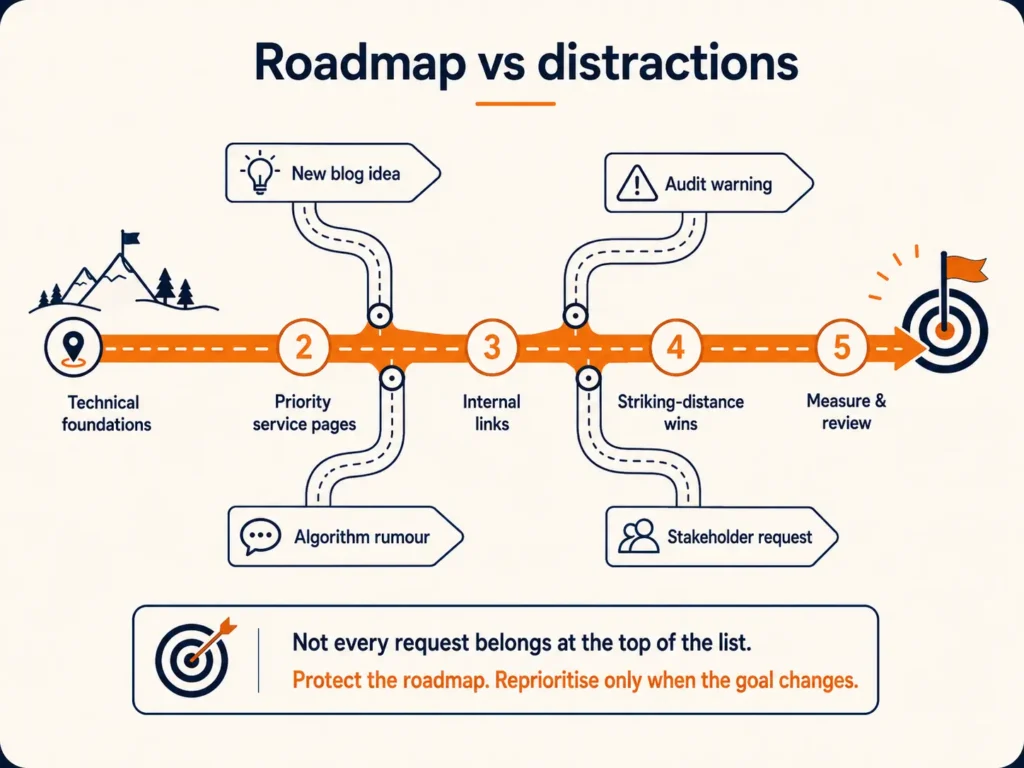
Once you’ve established your SEO priorities, share the reasoning with other stakeholders. It’s much easier to defend the roadmap later if people understand why certain tasks made the list – and why others did not.
Speaking from experience, I know this can sometimes be easier said than done!
Over the years I’ve had numerous clients who had their own ideas about what they thought I should be prioritising.
For example, sometimes they just want to start off with blogging – understandable from their point of view: an article is tangible evidence of doing something, unlike the invisible and frankly unglamorous task of fixing 404 errors or putting an internal link strategy in place.
The point is, perhaps you have stakeholders making demands of you, too? These all need to be considered carefully if they fall outside your carefully curated list of priorities. Assess their urgency and added value – if the business goals have genuinely shifted, you might need to reprioritise.
What next?
Find out more about my SEO audits and troubleshooting support, or get in touch if you’d like help turning a long SEO to-do list into a manageable, practical action plan.

About Mandy Cochrane
Mandy Cochrane is an independent SEO consultant with more than 15 years’ experience helping businesses improve their visibility in search. She specialises in SEO audits, strategy and content, with a practical, plain-English approach that helps businesses understand what needs fixing, what matters most and where their time and budget will have the greatest impact.
Connect: