

Should Each Service Have Its Own Page? How to Decide for SEO
If your business started small, with a website that offered several different services, there’s a good chance they all started life together on one page.
Perhaps you have a main Services page with a short paragraph about each thing you do. Or perhaps, as happens surprisingly often, your Home page has gradually become the place where everything lives.
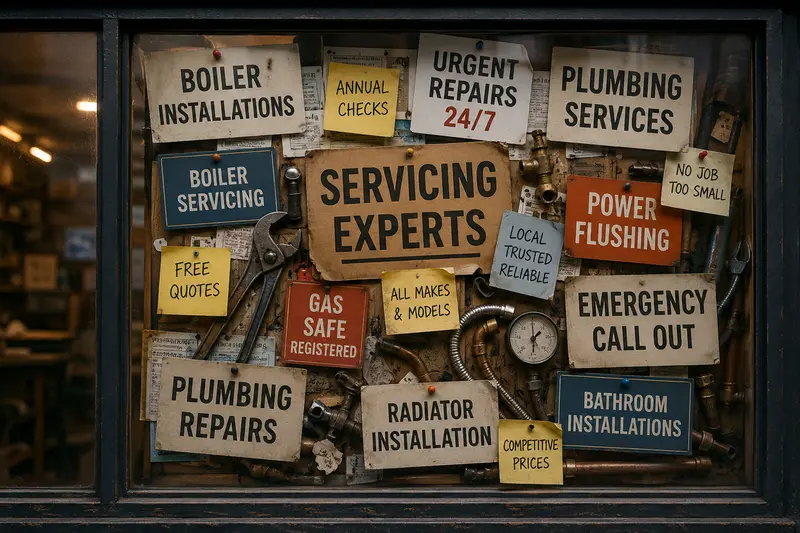
Boiler installations. Servicing. Repairs. Plumbing. Power flushing. Radiators. Emergency call-outs.
All perfectly clear to you, because you know your business inside out. But is one page really the best way to present all of those services to Google – or to the potential customer who’s arrived looking for one very specific thing?
Quite often, the answer is no.
In this article, we’ll explore whether every service you offer should have its own page, or whether just some services merit a dedicated page. I’ll also give you some practical tests to help you decide.
- The right question: “Which service deserves its own page?”
- Why one general Services page can hold you back
- Dedicated service pages aren't just about adding more keywords
- But does that mean every service needs a page?
- Think about the customer's decision, not just your service names
- Customers don't always search for the name of your service
- The simplest test: could you genuinely write a different page?
- A practical decision framework: does this service deserve its own page?
- Sometimes, closely related services should stay together
- Should you still have a main Services page?
- What if your existing Services page already ranks?
- You don't need to create everything at once
- A real example from an SEO audit
- How do you know whether the new pages are working?
- So, should every service have its own page?
- FAQs
The right question: “Which service deserves its own page?”
Creating separate pages for your most important services can give each one far more opportunity to appear in search results. It also gives potential customers better information and makes it easier to persuade them that you’re the right business for that particular job.
But there’s an important qualification.
“One service = one page” is not a rule of SEO.
Creating a separate page for every item on your service list can sometimes leave you with a website full of thin, repetitive pages that aren’t especially useful to anyone, whether that’s a customer or a search engine.
So the better question isn’t:
“Should every service have its own page?”
It’s:
“Which of my services genuinely deserve a page of their own?”
And fortunately, there are some fairly practical ways to decide, which I’ll dive into shortly.
Why one general Services page can hold you back
Let’s start with the reason separate service pages are so often recommended. Imagine you run a heating company offering:
Let’s say your website has one page explaining all six, and then imagine that someone searches Google for:
“boiler servicing near me”
Your Services page might contain a couple of paragraphs about boiler servicing. But the rest of the page talks about installations, repairs, plumbing, radiators and everything else you do.
Now imagine one of your competitors has a whole page specifically about boiler servicing. That page explains:
Which of those two pages gives Google – and the customer – the clearest indication that it’s a good result for someone specifically interested in boiler servicing?
Usually, it’s the dedicated page.
That isn’t because Google has a rule somewhere saying “thou shalt create a page for every service”. It’s simply that a focused page gives you much more scope to provide useful, relevant information about that particular subject.
Dedicated service pages aren’t just about adding more keywords
The SEO argument for separate pages is often reduced to keywords: create another page, target another keyword, rank for another search.
If only SEO were quite that accommodating!
The real advantage is that a dedicated page allows you to answer a specific customer need properly. For example, someone looking for an emergency boiler repair is in a very different frame of mind from someone considering replacing a 15-year-old boiler.
The repair customer might want to know:
Compare this with the questions someone considering a new boiler might have:
Those two customers don’t just type different things into Google. They need different information before they’re comfortable contacting you. Trying to serve both of them with a couple of paragraphs on the same general page doesn’t give you much room to do either job particularly well.
A dedicated page can also include evidence that’s relevant to that specific service: photographs, testimonials, case studies, qualifications or examples of completed jobs.
And the call to action can be more appropriate, too.
“Book your boiler service” is more useful to someone ready to arrange servicing than a generic “Contact us” button sitting beneath a list of six unrelated services.

But does that mean every service needs a page?
No. This is where otherwise sensible SEO advice can get slightly carried away.
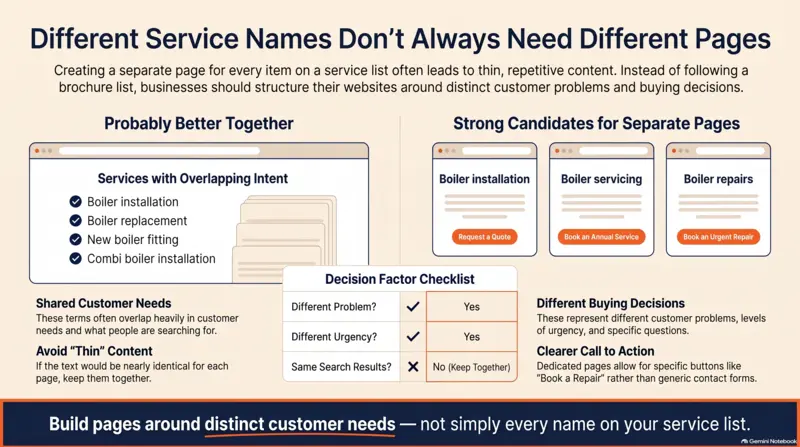
Businesses naturally organise their services into categories. But your internal service list isn’t necessarily a ready-made plan for your website.
You might list:
Are those definitely four separate pages? Not necessarily. There may be differences between them, but from a customer’s point of view they could represent very similar needs and very similar buying decisions.
If each page would end up saying roughly:
“We install high-quality boilers. Our experienced engineers will discuss your requirements, recommend the right solution and provide a professional installation…“
…changing “boiler installation” to “boiler replacement” every few paragraphs doesn’t suddenly turn it into a substantially different page. You’ve created another URL. You haven’t necessarily created anything more useful.
Contrast that with:
Those services are much easier to justify separately because the person searching for each one is trying to accomplish something different. That distinction matters more than the number of rows in your service spreadsheet.
Think about the customer’s decision, not just your service names
One of the best tests is to ask:
Is somebody choosing this service for a different reason?
For two proposed service pages, consider whether the customer has a different:
The more those things differ, the stronger the case for separate pages.
Take a builder offering house extensions and loft conversions. There will obviously be some overlap. Both involve construction work, planning, budgets, timelines and disruption.
But customers considering these services may have sufficiently different questions, search behaviour, practical concerns, examples they want to see and buying decisions to justify substantial individual pages.
Now compare:
single-storey rear extension and single-storey kitchen extension.
Could those also warrant separate pages? Possibly. But now we need more evidence.
Are people searching for them differently? Do they expect substantially different information? Could you write genuinely useful pages about both without repeating yourself? Are both commercially important?
This is where keyword research and looking at actual Google search results become much more useful than automatically following the business’s service menu.
Customers don’t always search for the name of your service
There’s another problem with building your website entirely around the terminology you use internally: your customers may not know that terminology. In fact, sometimes they barely know what they need at all.
A customer might not search for:
power flushing service
They might begin with:
why are my radiators cold at the bottom? Or radiators not heating properly.
Similarly, a business looking for SEO help may not initially search for an SEO audit. They might search: why has my website traffic dropped?
The business organises its offering around the service it sells. The customer often begins with the problem they want solved.
That doesn’t mean every problem-based search needs its own service page. Some will be much better answered with articles, guides or FAQs. But it does mean your website structure shouldn’t be based purely on what you’ve decided to call your services.
Good keyword research asks how your customers describe their problems, what they search for and what type of result Google tends to show them.
Check whether Google treats the services as different things
One practical way to investigate whether two topics deserve separate pages is simply to search for them.
Suppose you’re deciding whether boiler installation and boiler replacement need separate pages.
Search each term and compare the results. Do largely the same pages appear for both searches? If they do, that’s a clue that Google may see the two searches as having very similar intent.
If the results are substantially different – different types of businesses, different kinds of pages, different information – there’s a stronger argument that separate pages could be justified.
This isn’t an infallible test, but it’s much more useful than deciding: “They’re two services in our brochure, so we’d better make two pages.”
Search engines are increasingly good at recognising that several different phrases could refer to essentially the same underlying need. You don’t need a new page every time someone describes the same thing differently.
The simplest test: could you genuinely write a different page?
This is probably my favourite test because it quickly exposes service pages that exist mainly because somebody thought the website needed another URL.
Before creating a page, ask yourself:
Could we write something genuinely useful here that wouldn’t mostly duplicate another page?
For example, could you discuss different:
You don’t need every item on that list to be different. There will naturally be some overlap across pages belonging to the same business. Your company information doesn’t suddenly change because somebody clicked from “Boiler Repairs” to “Boiler Servicing”.
But each page should have enough substance of its own to justify its existence.
If your five proposed pages would all contain the same introduction, same benefits, same process, same testimonial, same FAQ answers and same call to action – with little more than the service name changed – I’d question whether you really need five pages.
More pages isn’t automatically better SEO.
Sometimes one excellent page covering a closely related group of services is considerably more useful than four anaemic ones.
A practical decision framework: does this service deserve its own page?
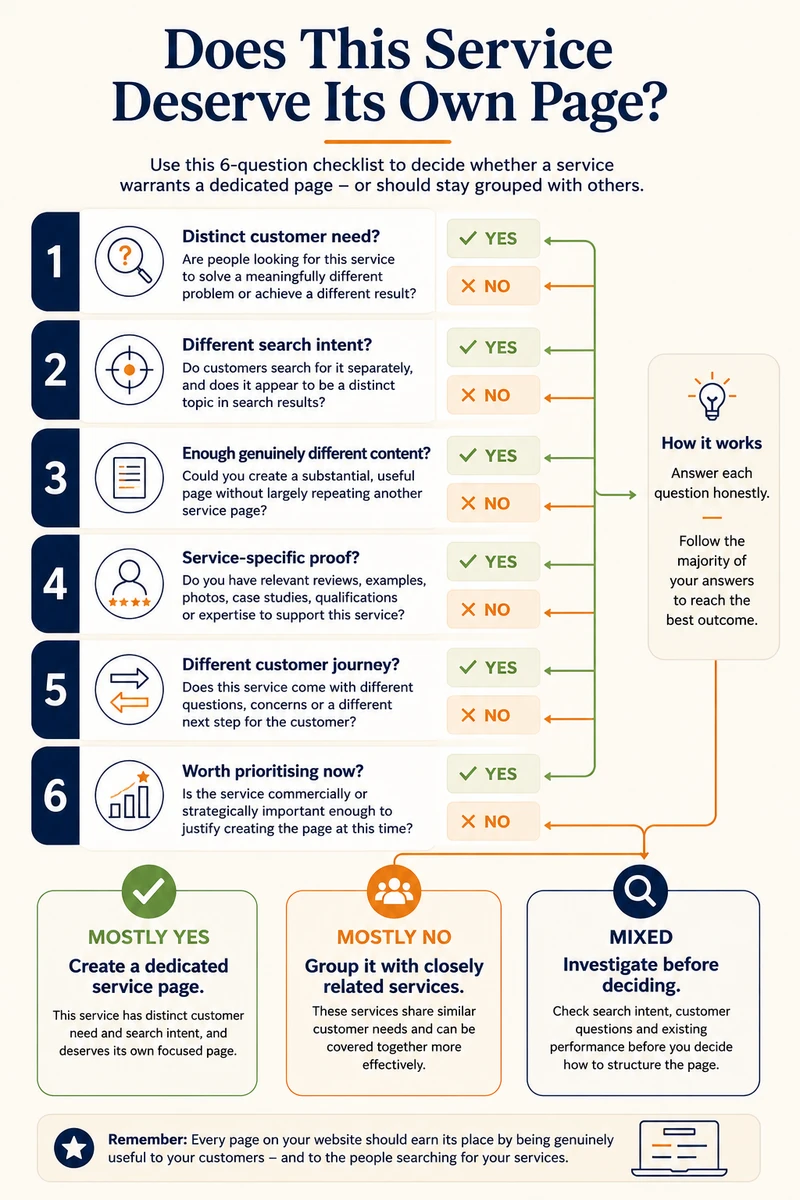
If you’re staring at your service list wondering where to draw the line, work through these six questions to help you decide.
1. Does it meet a distinct customer need?
Would customers actively seek this service out separately? A person searching for boiler repair has a very specific problem. That’s a strong sign it deserves dedicated treatment.
An optional magnetic filter fitted as part of a boiler installation probably doesn’t require the same prominence.
2. Is the search intent genuinely different?
Do people searching for Service A appear to want something different from people searching for Service B? If the same pages consistently satisfy both searches, combining them may make more sense.
3. Is the service commercially important to you?
Search volume isn’t the only consideration. Perhaps a particular service doesn’t attract enormous numbers of searches, but each resulting job is valuable and it’s exactly the type of work you want more of. That can make the page commercially worthwhile.
Conversely, there’s little point spending hours creating a highly polished page for a minor service you’d rather not sell very often anyway.
SEO should support the business you want, not immortalise every service you’ve ever offered.
4. Can you create genuinely useful, different content?
Could you answer meaningful questions about this service that don’t simply repeat another page? Do you have relevant examples, photographs, expertise or advice?
If yes, that’s another strong argument for creating the page.
5. Do you have evidence to support it?
A good service page shouldn’t just tell people how wonderful you are. Ideally, it can show them. That might include:
Service-specific evidence is particularly powerful because it reassures customers that you’ve dealt with their particular type of problem before. Find out more about why trust signals are important for SEO.
6. Does the customer need a different next step?
Should they:
If the appropriate next step changes significantly between services, giving each one its own page can create a much clearer customer route towards enquiry.
What if the answers are mixed?
Not every decision will produce six emphatic yeses. If most answers are yes, the service probably deserves its own page. If most are no, it may be better grouped with closely related services. If you’re somewhere in the middle, consider a broader category page.
For example:
Heating Services
could contain several closely related minor services while linking to substantial standalone pages for:
You don’t have to force the website into either “one enormous Services page” or “47 individual pages”. There’s plenty of sensible territory in between.
Sometimes, closely related services should stay together
Combining services is not an SEO failure.
If several terms describe essentially the same customer need, keeping them together can produce a stronger page.
Imagine a decorator offers:
Unless there’s a genuine difference in what those services mean to customers, four separate pages would probably be rather too enthusiastic. One strong Interior Painting & Decorating page could naturally discuss all of them.
The same principle applies where something is really an add-on rather than a standalone buying decision.
For example, if customers almost never purchase Service B without Service A, you may not need a separate sales page for B. You can still give it some prominence within the main service page, and potentially create supporting informational content, especially if customers ask questions around it.
The goal isn’t to create the maximum possible number of URLs. It’s to create the right pages.
Should you still have a main Services page?
Usually, yes. A main Services page and dedicated service pages aren’t alternatives. They can work very nicely together.
Think of the main Services page as the overview. It explains the areas you work in and helps customers find the appropriate part of the website. For example:
Our Services
Each link then takes the visitor to a much more useful page.
This structure also helps search engines understand the relationship between your pages. And from a user’s point of view, it’s considerably easier than asking them to scroll through one page the length of a small Victorian novel to find the two paragraphs that concern them.
What if your existing Services page already ranks?
This is where I’d add a note of caution.
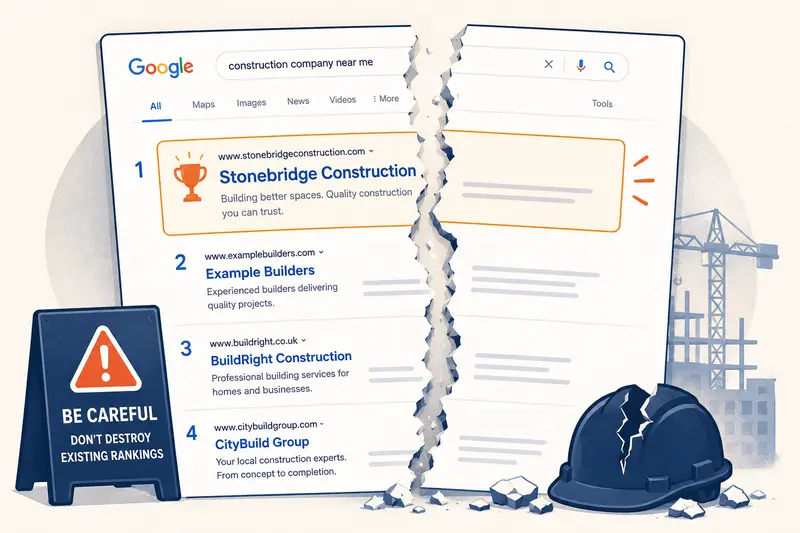
If you already have an established website, don’t immediately tear your Services page apart simply because you’ve decided separate pages sound better.
First, find out what’s currently working. Google Search Console can show you:
You may also need to consider whether the existing page has links pointing to it from other websites and how your own internal links currently work.
Suppose one general page currently ranks reasonably well for boiler servicing, but you create a new Boiler Servicing page without thinking about the old one. You could end up with two pages that appear to be trying to answer the same search.
That doesn’t mean you shouldn’t restructure the website. It simply means the change needs planning.
Depending on the situation, the existing page might remain as a Services overview, be substantially rewritten, or be replaced with a new structure using appropriate redirects. The important thing is not to throw away existing visibility accidentally while pursuing new visibility.
Check what you have before you start moving the furniture.
You don’t need to create everything at once
Let’s say your website currently has one general Services page. You’ve followed the questions above and decided that seven services could genuinely justify separate pages.
I’m a realist – you’re running a business; you don’t need to disappear for three months while you write all seven before doing anything else. Set some priorities. I’d usually look first at a combination of:
Commercial value
Which services are most important to your business? Which generate the best customers, revenue or profit?
Search demand
Are people actually looking for them? You don’t necessarily need enormous search volumes, particularly for a local service, but some evidence of demand obviously helps.
Distinct search intent
Which services have the clearest standalone need?
Ability to compete
If the search results are dominated by enormous national companies, directories and very strong websites, you may need to be realistic about how quickly a new page can compete.
Your ability to produce a good page
Do you have enough expertise, examples, customer questions, photographs and other useful information to make the page worth visiting?
Start where those factors overlap.
A builder might decide that House Extensions, Loft Conversions and Garage Conversions deserve attention first, while several lower-value minor services remain grouped on a broader page for the time being.
That’s perfectly reasonable. Three useful, well-developed service pages are better than ten rushed ones. You can always expand the website gradually.
A real example from an SEO audit
This issue came up recently when I carried out an SEO audit for HomeGuard Heating Solutions.
HomeGuard already had a lot going for it. The website looked professional. The business had excellent customer reviews, clear pricing information and a good Google Business Profile.
But the website was asking its Home page to do an awful lot of work. It needed to represent services including boiler installations, boiler servicing, boiler repairs, plumbing, radiators, power flushing, home-care plans and emergency work.
Those aren’t merely different labels for the same job.
Someone needing an urgent repair isn’t making the same decision as someone researching a replacement boiler. Their searches, questions, priorities and expectations are different.
Giving the most important of those services proper pages of their own therefore gives HomeGuard much more scope to create useful information around each one and establish stronger relevance for specific searches.
But – and this is important – my recommendation wasn’t:
“List absolutely everything you do and create one page for every item.”
The aim is to identify the services that represent meaningful customer needs and worthwhile search opportunities, then build useful pages around those.
You can read the full HomeGuard Heating Solutions SEO audit case study if you’d like to see some of the other issues and opportunities the audit uncovered.
How do you know whether the new pages are working?
Once you’ve created separate service pages, don’t judge them purely by whether you can find yourself on page one of Google.
Rankings are useful, but ultimately, they’re only part of the picture. Look at whether the pages begin to generate:
And pay attention to which enquiries you’re getting. A page that brings 200 visitors and no useful enquiries may be less valuable than one bringing 30 highly relevant visitors who regularly become customers.
Traffic for traffic’s sake doesn’t pay many invoices. The best website structure is the one that helps the right people find the right service and makes it easier for them to take the next step.
So, should every service have its own page?
No.
But your important services often deserve considerably more than a paragraph buried halfway down a general Services page.
A dedicated service page is usually worth considering when:
If several service names simply describe variations of the same underlying job, grouping them into one strong page may be the better option.
That’s why I don’t particularly like the rule “one service, one page”.
A better principle is:
One useful page for each distinct customer need and buying decision – where the service genuinely warrants it.
Every page should earn its place.
And if you’re not sure whether your existing service pages should be expanded, combined or reorganised, that’s exactly the sort of question a good SEO audit should help answer.
FAQs
If you’re unsure how to structure your service pages to maximise their impact to search engines and potential customers, a chat about content strategy could help you make sense of things.

About Mandy Cochrane
Mandy Cochrane is an independent SEO consultant with more than 15 years’ experience helping businesses improve their visibility in search. She specialises in SEO audits, strategy and content, with a practical, plain-English approach that helps businesses understand what needs fixing, what matters most and where their time and budget will have the greatest impact.
Connect: