

Using AI to Write Website Content? Google’s Latest Guidance
In early October 2026, Google updated its advice for businesses using generative AI to create website content.
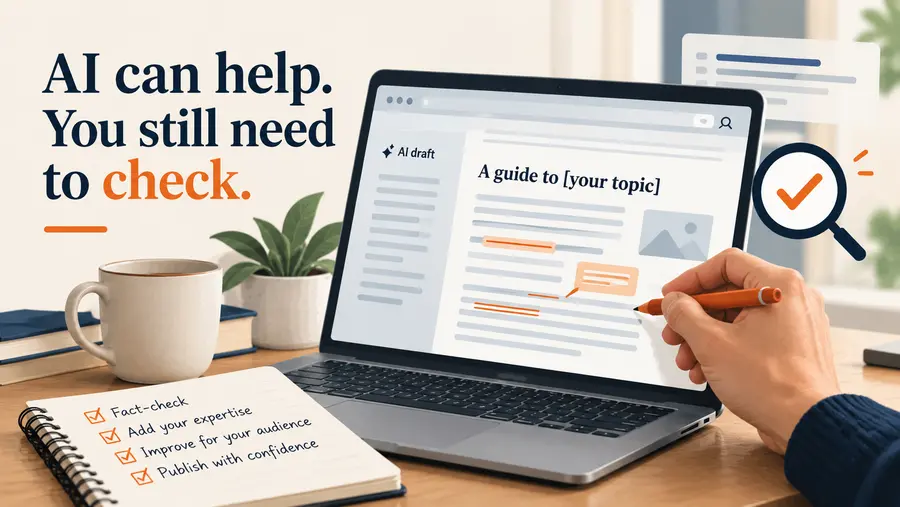
If you don’t have time to read the whole document yourself, here’s the main takeaway. Google hasn’t told users to stop using tools like ChatGPT, Perplexity or Claude. But it has strengthened a very important piece of advice: it now explicitly says that it’s critical to fact-check and review everything AI produces before it goes live.
It’s long been known that AI is capable of producing a plausible-sounding answer without actually knowing that the answer is true. Google’s latest guidance points this out, with a simple explanation of why that happens: generative models don’t retrieve facts; they predict a likely sequence of words based on their training data. Because of this, generative AI outputs sometimes contain inaccuracies (known as hallucinations).
By referring so specifically to this problem, Google emphasises how important it is to manually verify factual information in any AI content.
Haven’t we been here before?
In a way. Google’s guidance around acceptable AI use has evolved, becoming clearer and more specific over time as AI use became more widely adopted.
The early days of AI content – a detection game
When AI tools like ChatGPT exploded into mainstream UK use early in 2023, there was initially a fear that Google might demote AI-generated content (despite Google not having taken an official stance on it at that point). AI detector tools popped up everywhere, and for a while, website publishing was in this odd situation of trying to persuade one computer that another computer hadn’t written something!
Google’s initial clarification about how it treated AI-generated content
By February 2023, Google issued some guidance: good content was good content, “however it is produced”. Google was essentially saying that using AI responsibly was fine. Google’s publishing criteria remained the same, regardless of how the content was produced:
This clarification helped publishers relax somewhat and start to use AI tools more confidently. But a schism was emerging, between those who were using AI as a tool to make useful content even better, and those who saw it as a cheap route to scale up the pace of content production.
Google’s latest guidance
This latest clarification has made explicit something that was already implicit in Google’s guidelines:
It’s your responsibility for checking the finished content, regardless of how it’s produced.
Editing AI content isn’t the same as checking it
It’s a distinction that’s worth mentioning: Changing a few words here and there, removing phrases that sound a bit “AI-ish” or proofreading an AI piece for grammatical errors does not constitute a proper review.
A genuine review will ask, “Is this factually accurate?”, instead of, simply, “Does this sound alright?”
How AI can genuinely help your content pipeline
AI genuinely can enhance the usefulness of your content in many ways. Google understands this, and even points out how helpful AI can be for researching a topic and adding structure to original content.
I’m open about the fact that I use ChatGPT almost every time I prepare a piece of content for my website, including this one. For example:
In other words, AI helps me get from a blank page to a working draft. What I would never do is sacrifice my own editorial judgement or expertise to AI, or accept a fact without verifiable evidence.
Where things can go wrong
There are four main areas where AI-generated content needs careful checking:
1. Confidently wrong information
As mentioned earlier, AI can sometimes generate content that sounds so plausible, you might not fact-check it. Never-the-less, it could be wrong.
2. Invented sources, figures or examples
AI can fabricate research, statistics, quotations, product details, regulations or references (this famous example about a legal case in the U.S.A. is a case in point). This is bad news for anyone, at any time, but particularly for publishers in the health, finance or legal sectors, where Google expects considerably higher reliability on these subjects.
3. It doesn’t say anything original
Even perfectly accurate AI-generated copy can sometimes be bland. Let’s remind ourselves of Google’s criteria for content: “Is it useful? Is it original? Does it add something worthwhile?”. Most of the time, AI can only reproduce ideas and concepts that already exist online elsewhere. It might phrase those ideas like a professional copywriter, but it’s still unoriginal.
The solution to this is to add content to your drafts that AI has no direct experience of, e.g.:
I often add personal anecdotes and examples to content, even when AI has given me a perfectly rounded outline for an article, because these are the things that make a page useful and distinctive.
Publishing at scale, because you can
Google makes another statement in its guide for using generative AI content on your site: “…using generative AI tools or other similar tools to generate many pages without adding value for users may violate Google’s spam policy on scaled content abuse.”
In other words, producing 50 lightly edited pages because AI makes it cheap, fast and easy isn’t automatically a clever SEO strategy. Google’s scaled-content-abuse policy specifically targets large amounts of unoriginal, low-value content produced primarily to manipulate search results – regardless of whether humans or machines made it.
This isn’t something I’ll ever need to worry about, but I’ve met people who have flirted with this kind of strategy. A while back, for example, I was chatting with a business-owner for whom I hoped to do some SEO. About 20 minutes in, they breezily talked me through their plan to have AI scale up and fully create their content going forward. You can imagine how I tried to steer the conversation at that point, but they were determined to do it.
There’s really not very much you can do or say in the face of such wilful determination to close your ears to sensible advice. I wished them well and hoped they didn’t waste too much time or effort before they realised that just because you can, it doesn’t mean you should.
A practical AI publishing checklist
Before publishing anything AI has helped create, ask:
- Are the facts correct? Check names, dates, figures, claims and quotations against reliable original sources.
- Can I verify the sources? Don’t assume a reference exists simply because AI supplied one.
- Does this reflect what my business actually does? Check services, prices, guarantees, locations, processes and policies.
- Have I added something AI couldn’t know? Your experience, examples, opinion, customer questions or first-hand knowledge.
- Would I be happy to put my name against this? That’s probably the best test of all.
Final thoughts
Google’s latest guidelines update couldn’t be clearer, and if you value your content’s performance, you should take it seriously. AI has made creating content faster, but the responsibility for that content remains with the business publishing it.
And quite honestly, without or without Google’s advice, if you’re putting information on your website under your business name, you should know that it’s accurate, useful and trustworthy.
If you publish content on your site, but need help making it stand out from your competitors, I can help with everything from topic and keyword research, to first drafts or an original, in-depth, finished piece. Explore Content Services for SEO.

About Mandy Cochrane
Mandy Cochrane is an independent SEO consultant with more than 15 years’ experience helping businesses improve their visibility in search. She specialises in SEO audits, strategy and content, with a practical, plain-English approach that helps businesses understand what needs fixing, what matters most and where their time and budget will have the greatest impact.
Connect: