

Why Your SEO Hasn’t Worked – Even If You’ve Been “Doing SEO”
I understand the frustration. You know SEO can work…it just hasn’t worked for you! Not yet, anyway. You’ve paid agencies, published blogs, installed tools and followed umpteen SEO tactics, but the end result is always vague recommendations, generic reports and endless “activity” that doesn’t translate into commercially useful results.
When results don’t happen, it’s natural to wonder whether it’s worth spending more of your hard-fought marketing budget on SEO.
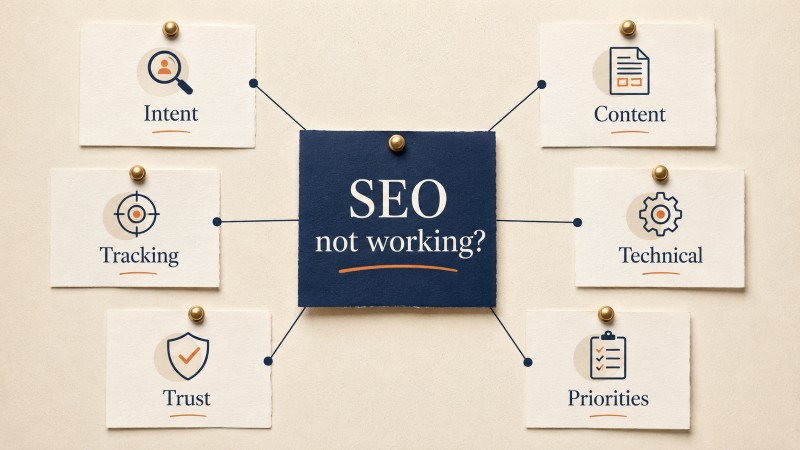
But poor results don’t always mean SEO is wrong for the business. The issue is often strategy, prioritisation, measurement, implementation or expectations.
If SEO has disappointed you in the past, these are the areas I’d want to investigate first.
1. Wrong search intent or audience
A page can rank. A blog can get traffic. Impressions can rise. But SEO has failed if the content doesn’t match what the searcher actually wants at that stage of their buying journey, because it won’t produce enquiries that are commercially meaningful.
Traffic is not the same as useful traffic.
Understanding search intent is a core principle of SEO. Ahrefs defines search intent as “the reason behind a query”. It essentially translates to what the person is trying to find, solve, compare or buy. Google’s own people-first content guidance repeatedly pushes creators to focus on whether content is genuinely useful to the intended audience, rather than created mainly to score rankings.
If you can identify with any of the following, it may have contributed to a failed SEO strategy:
- Targeting broad informational searches when the business needs qualified leads.
- Example: “Legal process for buying a house”, instead of “Residential conveyancing solicitor in [Location]”.
- Writing “what is…” or “how to…” articles which attract DIY researchers rather than the person looking for expert help.
- Example: “How to calculate inheritance tax liability”, instead of “Inheritance tax planning consultant”
- Choosing keywords because they have volume, not because they are very specific to your business.
- High volume keywords are usually broad, competitive, hard to rank and not necessarily well targeted to your customers.
2. No coherent content strategy
A lot of SME SEO activity consists of disconnected content production without a joined-up content strategy behind it. There may be sporadically published blogs, tweaked titles, added keywords, maybe updated some service pages, but there’s no clear map connecting search demand, customer questions, business priorities and the sales journey.
More content is not always the answer. Better-connected content usually is.
Do you recognise any of the following?
- Blog topics chosen because “we haven’t posted anything for a while”.
- Content only targets top-of-funnel questions (the awareness and discovery stage of a buyer’s journey).
- Service pages are weak, while blog content does the heavy lifting in terms of attracting traffic and trying to funnel it to service pages.
- Old content is left to decay.
- Multiple pages on overlapping topics compete for similar terms.
- No understanding of what the best customers search before contacting a supplier.
If these resonate with you, a more joined-up content strategy should be a priority, including researching customer personas, keyword and topic research, a thorough audit of existing content and a planned content strategy that supports customers’ journeys at every stage.
3. Poor or generic content
Now that AI has made it easier to produce large volumes of bland content at scale, it’s not enough to publish content because “SEO needs blogs.” The content has to deserve visibility – and the reader’s attention.
Google rewards helpful, reliable, people-first content. It offers self-assessment criteria that help you consider whether your content provides original information, substantial value, expertise, and a satisfying experience for readers.
SEO can fail when content is:
- Too short to answer the question properly.
- Too long to answer the question succinctly (I know!).
- Too generic to show real expertise.
- Too similar to competitor content.
- Written around keywords, not customer needs.
- Published without examples, opinion, evidence or business insight.
- Created by AI, lightly edited, but not meaningfully improved.
- Disconnected from the company’s actual services.
If your content could appear on any competitor’s website with only the logo changed, it’s probably not doing enough.
4. Weak measurement
When you’re responsible for reporting on SEO for your organisation, it’s important to have confidence in the data. But when data sources are misconfigured, or data is ignored or misunderstood, you’re not getting the whole truth.
You may be reporting on traffic, while missing the enquiries that actually matter.
If the tracking is wrong, the conversation about SEO performance will be wrong too.
Weak measurement, whether it’s in Google Analytics, Search Console or other tools, means you’re flying blind… SEO might be working, or it might look like it’s working; it might be failing, or look like it’s failing.
SEO may look like it has failed when:
- Conversions are not tracked properly.
- Form submissions, phone clicks or email clicks are missing.
- GA4 events are not marked as key events.
- Branded and non-branded traffic are lumped together.
- Ranking improvements are tracked but lead quality is not.
- Reports focus on vanity metrics.
- Nobody has agreed what success should look like.
5. Lack of prioritisation
You’ve probably got an SEO to-do list as long as your arm. Some of it may be useful; some irrelevant. Some may be technically correct but the commercial impact for your organisation is low. Without prioritisation, SEO becomes a swamp, decision-making becomes fragmented, or stalls altogether.
SEO fails when teams:
- Try to fix everything at once.
- Chase low-impact technical fixes and green ticks on scorecards.
- Publish content before fixing key service pages.
- Focus on high-volume keywords that are too competitive.
- Ignore pages already close to performing.
- Can’t distinguish urgent fixes from long-term improvements.
- Spread a small budget too thinly.
- Lack ownership for implementation.
The problem is not always that nothing has been done. Sometimes, plenty has been done, just not in the right order.
6. Poor or conflicting advice
In your quest for successful SEO, you may have heard contradictory advice from all directions: developers, agencies, LinkedIn posts, SEO tools and AI platforms. After a while, it becomes hard to tell the difference between what’s good, what’s impactful, and what’s just downright hogwash.
Checklists with green ticks aren’t an SEO strategy; tool scores showing a perfect 100% don’t move the needle from a commercial point of view.
SEO advice is only useful if it is specific enough to help you make a decision.
Poor advice may be:
- Generic checklist recommendations.
- Based on tool scores rather than actual business impact.
- Too technical, and not based on commercial priorities.
- Too content-heavy, while ignoring technical issues.
- Too focused on rankings rather than enquiries.
- Based on outdated tactics.
- Based on copying what competitors are doing.
- Not adapted to budget, resource or industry.
- Not connected to the business model.
7. Implementation gaps
Internal marketing teams often come to me because they’ve been told by the higher-ups in the organisation to improve website performance and grow leads. They commission SEO site audits, keyword and topic research, develop customer personas, discuss SEO strategies with me in great depth… and then, ultimately, struggle to get the plan implemented properly.
“Our SEO strategy exists, but execution fails because nobody internally has time to implement it – content and optimisation fall by the wayside.”
It’s not the marketing team’s fault. Common blockers to implementation are:
- No developer time.
- CMS limitations.
- Unclear ownership.
- Internal sign-off delays.
- Nobody translating strategy into actionable tasks.
- Recommendations are too vague.
- Competing marketing priorities.
- “We’ll get to that later” syndrome.
An SEO recommendation has no value until it becomes a live improvement on the website.
8. Weak trust signals
Google’s helpful content guidance encourages site owners to consider whether their content demonstrates first-hand expertise, and whether readers would feel they can trust the information.
This isn’t just an SEO concern for SMEs. Lack of trust affects conversions, too.
Trust gaps could include:
- A weak About page.
- No named experts or authors where appropriate.
- No case studies.
- Few testimonials or reviews.
- Vague service pages.
- No clear evidence of experience.
- No useful examples of work.
- Poor external reputation, or few quality mentions/links.
If a page does not give a potential customer enough confidence to enquire, it might also be harder for search engines to understand why that page deserves to be trusted and shown to users.
9. Technical barriers
Sometimes, it’s not the content or trust factors holding the site back – it’s technical problems: the site is hard to crawl, index, understand or use.
It’s often easier to focus on front-end problems and leave technical SEO for another day, especially if it involves costly developer time to put right. But unsound foundations can make it pointless doing other SEO work.
Common technical or site-quality problems:
- Important pages not indexed.
- Duplicate or near-duplicate pages.
- Poor internal linking.
- Slow or unstable pages.
- Broken redirects after a rebuild.
- Pages blocked accidentally.
- Poor mobile experience.
- Unclear site structure.
- JavaScript or CMS issues affecting visibility.
Technical SEO is rarely glamorous, but it’s often where hidden problems quietly sit, and limit the impact of the good SEO work being done elsewhere.
10. Unrealistic timescales
You’ve heard it so often it’s almost a cliché – “SEO takes time and consistency”.
Want evidence? Ahrefs published a study update in 2025 which found that 72.9% of pages ranking in Google’s top 10 were more than three years old, and only 1.74% of newly published pages ranked in the top 10 within a year.
That doesn’t mean that newer pages can never rank well, but it’s evidence that organic visibility is often built over time, particularly if your sector is competitive.
And that perennial question: “How long does SEO take to show results?” In my experience, allow a minimum of three to six months to start showing results, even up to 12 months, depending on competition, site history, available resources and the type of work being done.
SEO may underperform when:
- Work stops after one or two months.
- Recommendations are not implemented.
- Content is published sporadically.
- Technical fixes are delayed.
- No one reviews performance and adapts the plan.
- Expectations are based on paid ads timelines.
- Early signs of progress are missed because only final leads are measured.
SEO needs patience, but not blind patience. You should still be able to see whether the work is moving in the right direction.
11. Conversion problems
SEO can bring people to a website, but traffic growth alone doesn’t make for successful SEO – or leads – if the page doesn’t make it clear what the next step is.
Sometimes, SEO is blamed for a conversion problem.
Conversion problems include:
- Unclear messaging.
- Weak calls to action.
- Service pages that don’t answer buyer questions.
- No pricing guidance where appropriate.
- No proof or reassurance.
- Difficult contact process.
- Poor mobile experience.
- Pages written around the company rather than the customer’s problem.
Can a failed SEO strategy be turned around?
Yes, it can. As you’ve seen, SEO can fail for many reasons, but none of them are irreversible if you’re able to take ownership of the issues, prioritise them in a way that makes commercial sense for your business, and commit to implementing the right solutions.
You don’t need to start again blindly, but you do need the right diagnosis and measurement going forward. You need to understand what has been done, what has not, what mattered, and what should happen next.
A good SEO audit shouldn’t produce a giant list of problems; it should tell you where the real commercial opportunities and blockers are, and help you make practical decisions about the most impactful strategies.
If your business has tried SEO before and been disappointed by the results, or your marketing team hasn’t been able to implement an SEO strategy – for whatever reason – the next step is not necessarily to spend more or start again from scratch. It’s to find out what has really been holding things back.
My SEO Audit & Action Plan gives you a clear, prioritised view of what matters most, what can wait, and where your best opportunities are likely to be.
And if you already have an SEO strategy but need help implementing it, explore options for full or partially managed SEO plans.

About Mandy Cochrane
Mandy Cochrane is an independent SEO consultant with more than 15 years’ experience helping businesses improve their visibility in search. She specialises in SEO audits, strategy and content, with a practical, plain-English approach that helps businesses understand what needs fixing, what matters most and where their time and budget will have the greatest impact.
Connect: